
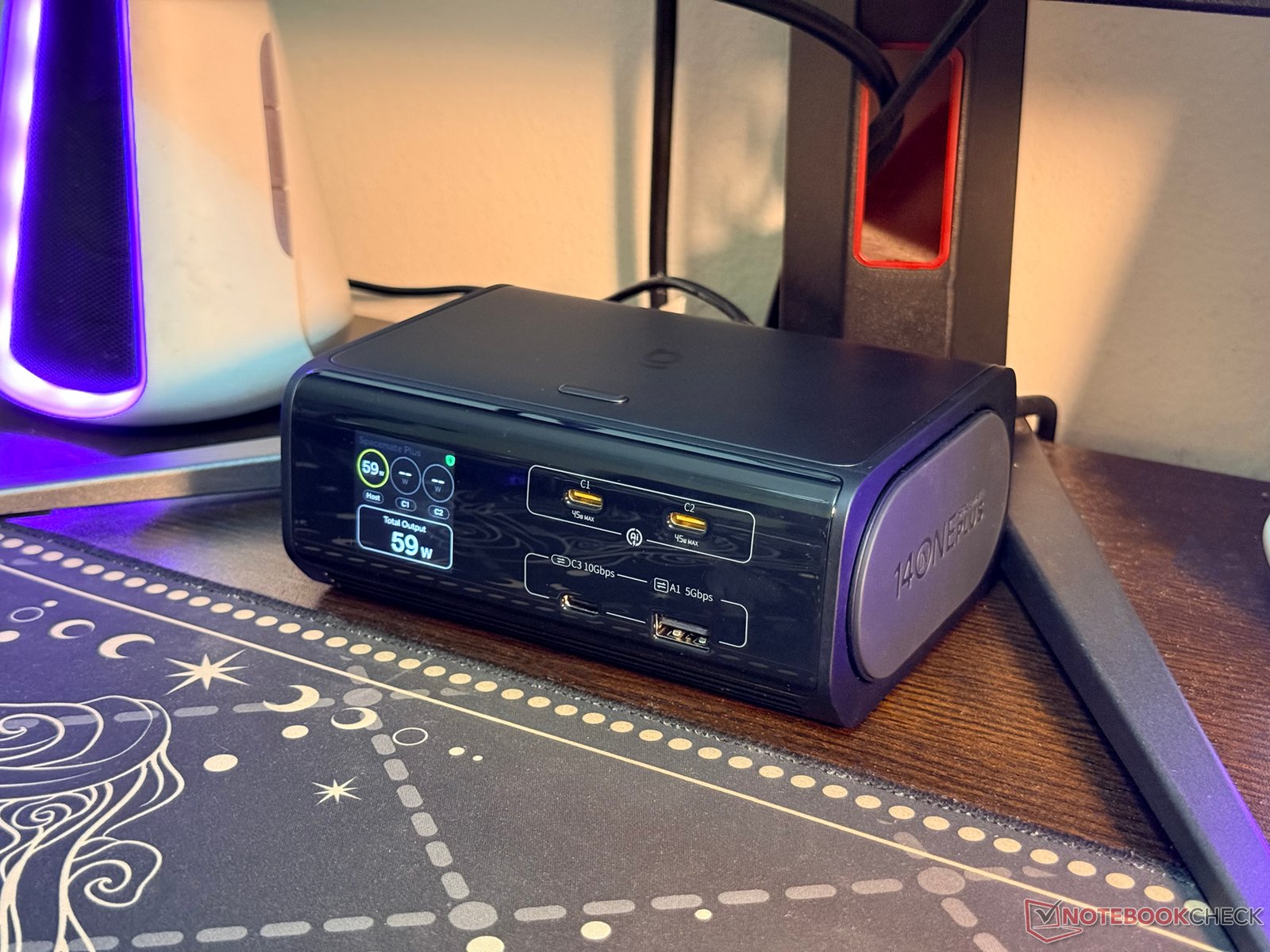
Baseus Spacemate RD1 Plus 14-in-1 USB-C Dock Review
Introduction
The Baseus Spacemate RD1 Plus arrives as a compelling mid-range option for professionals seeking a comprehensive USB-C docking solution. This 14-in-1 dock sits between the standard RD1 model and the premium Pro variant, offering a balanced feature set at a competitive price point. After extensive testing with multiple devices, I can confirm it delivers on its promise of workspace decluttering, though one significant video output constraint deserves careful consideration before purchase.
Design and Build Quality
The RD1 Plus maintains Baseus signature minimalist aesthetic with a matte aluminum chassis that complements modern laptops like the MacBook Pro M3 and Dell XPS 15. Measuring 5.9 x 2.4 x 0.7 inches, it occupies minimal desk real estate while feeling substantial enough to stay put during cable connections. The included 150W power adapter uses a standard figure-eight cable, allowing easy replacement if needed. A subtle LED indicator shows power status without being distracting in dark environments.
Port Selection and Connectivity
True to its 14-in-1 designation, the dock provides impressive versatility. The front panel houses a USB-C 3.2 Gen 2 port (10Gbps) supporting 15W charging, a USB-A 3.2 Gen 1 port (5Gbps), and 3.5mm audio combo jack. Rear connectivity expands to three USB-A 3.2 Gen 1 ports, one USB-C 3.2 Gen 1 port (5Gbps), gigabit Ethernet, SD and microSD card readers (UHS-I), and dual video outputs via HDMI 2.0 and DisplayPort 1.4. The host connection uses a tethered USB-C cable with 100W power delivery passthrough.
Video Output Limitations
Here lies the notable compromise mentioned in our title. Despite featuring both HDMI and DisplayPort outputs, the RD1 Plus cannot drive dual 4K displays simultaneously at 60Hz. The DisplayPort supports 4K at 60Hz or 8K at 30Hz, while HDMI maxes at 4K 30Hz. When both ports are active, the maximum configuration drops to dual 1080p at 60Hz or single 4K 30Hz plus 1080p 60Hz. This limitation stems from the dock reliance on DisplayPort 1.4 DSC (Display Stream Compression) through a single USB-C 3.2 Gen 2 upstream connection. Users connecting a MacBook Pro M3 or iPad Pro M4 will find single-display 4K 60Hz works flawlessly, but dual-monitor setups require resolution compromises.
Performance with Popular Laptops
Testing across multiple platforms revealed consistent performance. The MacBook Pro 14-inch M3 connected instantly with full 96W charging passthrough, though macOS does not support MST (Multi-Stream Transport) for independent dual displays over a single USB-C connection. Windows laptops like the Dell XPS 15 9530 and Lenovo ThinkPad X1 Carbon Gen 11 leveraged MST for extended desktop across two monitors at reduced resolutions. The Samsung Galaxy Book 4 Ultra handled single 4K 60Hz output perfectly while charging at 100W. Chromebook compatibility proved solid with the Acer Chromebook Spin 714, though video output options remain limited to Chrome OS capabilities.
Power Delivery and Charging
The 100W power delivery passthrough reserves approximately 15W for dock operation, delivering up to 85W to connected laptops. This sufficiently charges most ultraportables including the MacBook Air M3, HP Spectre x360 14, and Asus Zenbook 14 OLED. However, power-hungry workstations like the Dell Precision 5680 or gaming laptops such as the Razer Blade 16 may experience slower charging under heavy loads. The front USB-C port provides 15W for phone charging, conveniently powering an iPhone 15 Pro Max or Samsung Galaxy S24 Ultra during work sessions.
Comparison: RD1 vs RD1 Plus vs Pro
The standard Baseus Spacemate RD1 lacks the DisplayPort output, Ethernet port, and card readers, making the Plus model a clear upgrade for $30 more. The flagship Baseus Spacemate Pro adds Thunderbolt 4 support, dual 4K 60Hz capability, and 2.5Gb Ethernet, but commands a $120 premium. For most users connecting a MacBook Pro M3, iPad Air M2, or Dell XPS 13 Plus, the RD1 Plus hits the sweet spot of functionality and value.
Verdict
The Baseus Spacemate RD1 Plus delivers exceptional port density and build quality for its price class. Single-display 4K 60Hz workflows function flawlessly across Mac, Windows, and Chrome OS platforms. The dual-monitor limitation is the primary caveat, but professionals requiring only one external display or accepting 1080p secondary monitors will find this dock eliminates cable clutter effectively. At its current street price, it represents one of the best value propositions in the 14-in-1 docking category.