
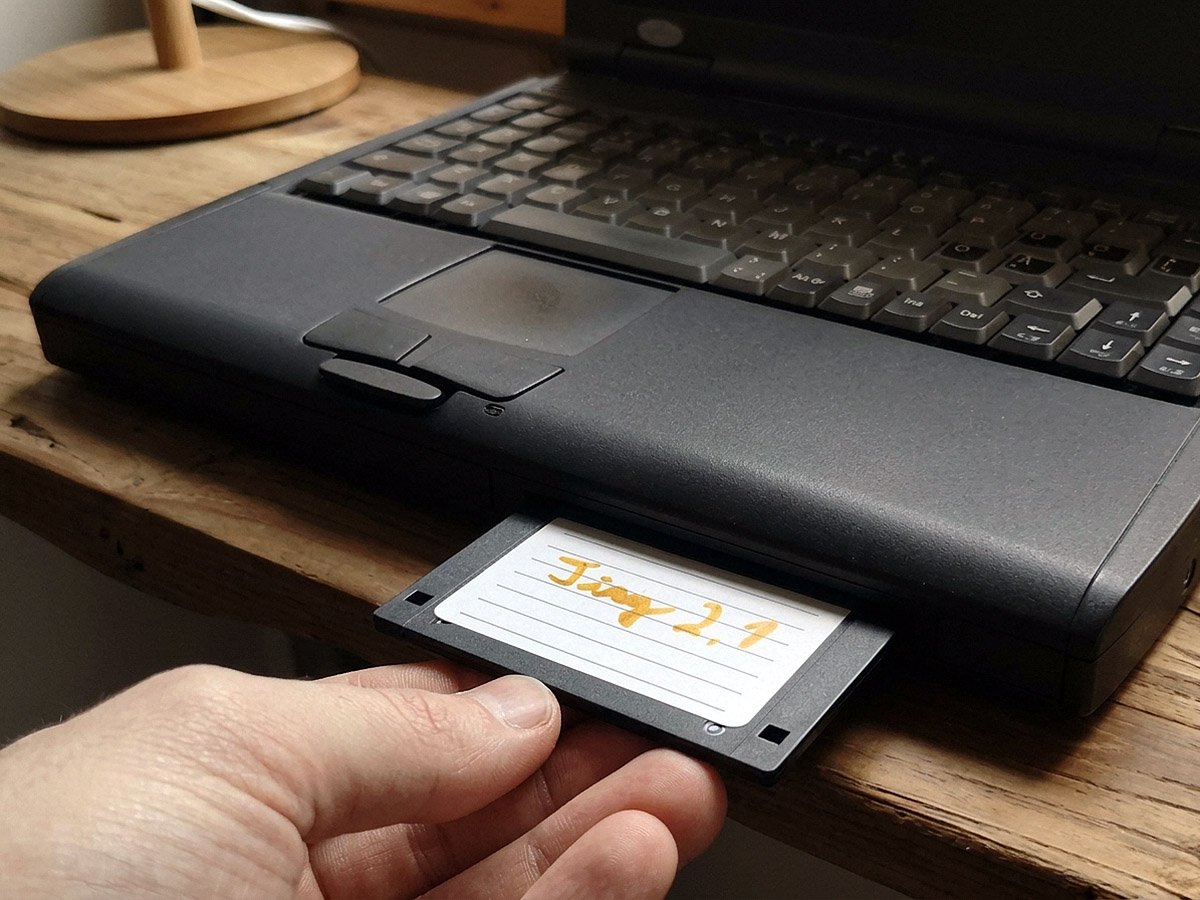
Tiny AI Model Runs on Vintage 486 DOS PCs From Floppy Disk
Tiny AI Breakthrough Runs on Decades-Old Hardware
In an era where artificial intelligence demands massive graphics processing units and terabytes of memory, a remarkable achievement has emerged from the retrocomputing community. Developer Claude Fable released version 5.2 of a compact AI system called Tiny 2.1 that operates entirely within the constraints of a standard 1.44 megabyte floppy disk. This minimalist model executes on vintage Intel 486 DX2-66 and Pentium 90 processors running MS-DOS 6.22, proving that sophisticated machine learning does not always require cutting-edge silicon.
Floppy Disk Storage Meets Neural Network Architecture
The entire Tiny 2.1 distribution fits on a single 3.5-inch high-density floppy diskette, the same medium that served as the universal save icon for generations of computer users. Unlike modern large language models that require NVIDIA RTX 4090 graphics cards with 24 gigabytes of video memory, this implementation weighs in at mere kilobytes. The model demonstrates basic natural language processing capabilities including text completion, simple reasoning, and pattern recognition without any graphical user interface or network connectivity.
Compatibility With Classic Business Machines
Testing has confirmed successful operation on period-correct hardware including the Compaq Deskpro 486/33M, IBM ThinkPad 755CD with its distinctive butterfly keyboard, and Dell OptiPlex GXa systems. These machines originally shipped with Windows 3.1 or Windows 95 but boot directly into MS-DOS mode for the Tiny runtime. The software leverages 16-bit real mode instructions and conventional memory below 640 kilobytes, avoiding extended memory managers entirely. Performance benchmarks show response times ranging from several seconds on a 486 SX-25 to near-instantaneous results on a Pentium 133 system.
Development Philosophy Embraces Radical Constraints
Claude Fable designed Tiny 2.1 as an exercise in extreme optimization, stripping away every non-essential component found in contemporary AI frameworks. The codebase contains no dependencies on Python interpreters, CUDA toolkits, or TensorFlow libraries. Instead it relies on hand-optimized assembly routines for matrix multiplication and activation functions. This approach mirrors the demoscene tradition where programmers create impressive audiovisual experiences within strict size limits, but applies those principles to neural network inference.
Implications For Edge Computing And Education
While Tiny 2.1 will not replace cloud-based services like ChatGPT running on Microsoft Azure ND-series virtual machines or Google Cloud TPU pods, it opens intriguing possibilities for computer science education. Students can examine a complete functioning neural network implementation in assembly language on hardware costing under fifty dollars on the secondary market. The project also demonstrates that inference workloads can scale down to microcontroller-class devices, relevant for Internet of Things applications where an ESP32-S3 or Raspberry Pi Pico W might benefit from on-device intelligence without cloud connectivity.
Community Reception And Future Development
The retrocomputing forums Vogons and Vintage Computer Federation have embraced the project with enthusiasts sharing benchmark videos captured on Sony Handycam DCR-TRV900 camcorders. Several contributors have ported the core inference engine to other 16-bit platforms including the Atari STe and Amiga 1200. Claude Fable has indicated that version 3.0 may add support for VGA text mode visualization of attention weights and integration with the mTCP packet driver for experimental networked inference across null-modem cables between two 486 machines.